
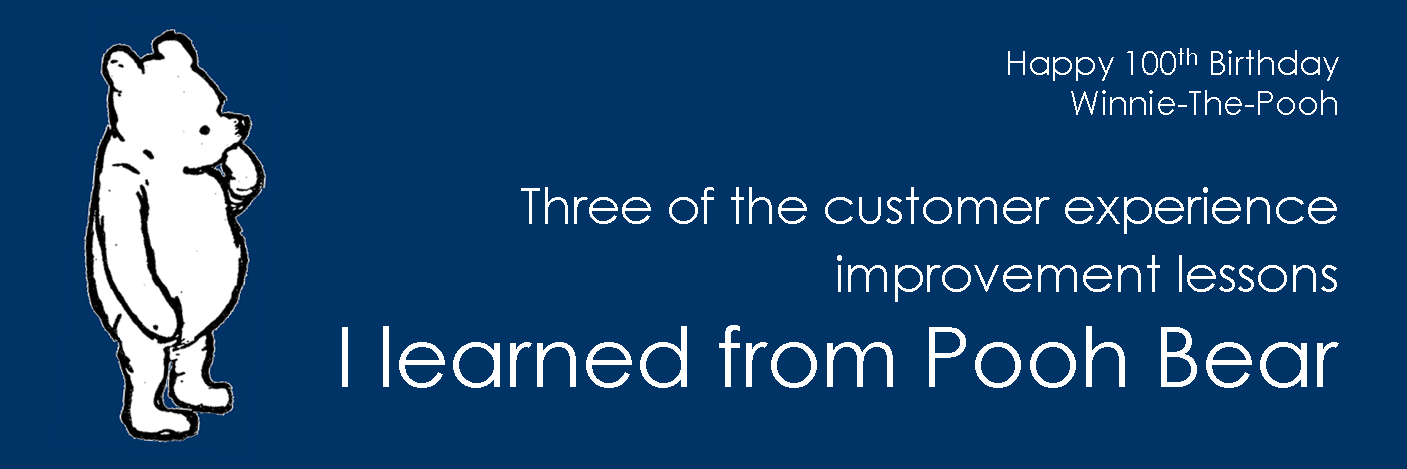
On this, his 100th birthday, I am drawn to remember three important customer experience improvement lessons that I learned from Pooh Bear.
A hundred years ago today, on 14th October 1926, the book “Winnie-The-Pooh”1 by English author A. A. Milne and beautifully illustrated by E. H. Shepard, was first published.
It is a favourite amongst children and parents ever since, and full of important lessons about life, friendship and loyalties. And, many of these lessons can also be applied today in understanding and improving relationships with, and the experiences of, customers.
So, bear with me, while I summarise three of these lessons that have inspired some of the guiding principles and frameworks I have included in my own book: “Customer Tuned Management Attitude - The ‘why’, ‘what’, and ‘how’ of building an adaptive customer-driven enterprise”.
1. There is always a better way
In Chapter 1 of “Winnie-The-Pooh” we are introduced to Pooh (AKA “Edward Bear”) as he is being dragged down the stairs behind his owner, Christopher Robin.
“Here is Edward Bear, coming downstairs now, bump, bump, bump, on the back of his head, behind Christopher Robin. It is, as far as he knows, the only way of coming downstairs, but sometimes he feels that there really is another way, if only he could stop bumping his head for a moment and think of it.”
In so many businesses and public sector organisations, everyone is so busy “bumping their heads” trying to meet deadlines, responding to customers, following procedures and chasing scores and KPIs, that they often don’t get a moment to think of another – better way of doing things.
It is important to make sure that the way you do things today, no matter how long you’ve been doing them that way, is constantly under review, open to criticism from staff and from customers, and is readily changed when a “better way to do things” is discovered.
2. Seeing things from your customers’ points of view
Now, Pooh Bear is very fond of honey, and this does seem to get him into awkward situations in a number of his adventures. But on one occasion, whilst carefully climbing a large oak tree to reach the honey in a nest of bees at the top, he thinks of a song. A song that to me, is a perfect metaphor for stepping into your “customers' shoes”.
“It’s a very
funny thought that, if Bears were Bees,
They’d build their
nests at the bottom of trees,
And that being so (if the Bees were
Bears),
We shouldn’t have to climb up all these stairs”
The lesson here is that a customer’s view of your organisation is likely to be very different from yours. Customers tend to focus on two things:
- The “problem” or “need” they want your product or service to solve
- The “benefit” (i.e. the degree to which your products or services will solve it)
But to solve it, you need to take care of everything between the
moment they discovered that they had this need, to the point they receive
your solution.
OK, so let’s ignore the fact that the bees don’t really want bears to get to their honey, but if they did, and Pooh was their “customer”, they would want make it easy for their customer to do business with them. They would build their nests at the bottom of trees. Just think about how many trees your customers may need to climb to reach your products and services.
3. Clearly distinguishing between apparent causes and root causes
In Chapter 3, on “One fine winter’s day…” we find Pooh and his friend Piglet puzzled as they follow a set of paw-marks in the snow.
Wondering what may have left the tracks, Pooh concludes: “I shall have to wait until I catch up with it” to find out.
So, joined by Piglet they continue to track the animal through the snow together.
But suddenly they find the set of tracks has been joined by another set of tracks.
“This – whatever-it-was – has been joined by another – what-ever it-was – and the two of them are now proceeding in company”.
The tracks lead the two friends around a small spinney of larch-trees, so they followed – only to discover a third set of tracks joining the set they were already following. With some anxiety, they continued to follow, until they seemed to be joined by a fourth set of tracks. Piglet’s fears of what type of animals they may be gets the better of him and he makes an excuse to go home, leaving Pooh alone with maybe as many as four whatever-it-wases to deal with.
But just in time, Christopher Robin, who has been watching from the branches of a nearby tree, points out to his “Silly old Bear” that they had been walking around and around the same spinney of larch-trees, leaving, and following their own set of tracks, adding to them at each circuit.
OK, a fun story, but an important lesson for customer experience improvement programmes. When looking for ways to prevent problems that customers sometimes experience is to identify the root causes. This often requires searching beyond the “apparent cause” because what customers and employees experience isn’t always the actual root cause.
In searching for a root cause it’s often helpful to look at the problem from a number of perspectives and keep asking questions.
For example, for each issue that needs to be addressed, ask:
- “Why does that happen?”
- “When does that happen?”
- “Where does that happen?”
- “What products and services suffer from this issue?”
- “Who does this issue affect?”
- “Does this happen to customers of other organisations?”
In asking these questions, it’s also often helpful to integrate
multiple sources of data to help narrow down and isolate a potential
root cause.
For example:
- Combining complaints and problem data with transaction data, product data, customer data and market research, or…
- Normalising complaints data against sales volumes, demographic and seasonal variations
Also, one of the most important sources of root cause insight can
come from discussing the findings with staff in other departments
(Christopher Robin). Not only are they likely to have experienced the
problem themselves, but they are also often in an excellent position to
understand why it may be happening and how to prevent it from happening
in the future.
Happy Birthday to Pooh Bear, and thank you A. A. Milne and E. H. Shepard for your wonderful stories, characters and illustrations.
Oh, and please let me know what you have learned from Pooh Bear.
1(Milne, A. A. (1926). Winnie-The-Pooh. Illustrated by E. H. Shepard. Methuen & Co. Ltd.)
© CTMA New Zealand Ltd.
Let’s talk
If you’re working to build an adaptive customer-driven
enterprise, check-out our book “Customer Tuned Management Attitude” on
Amazon.com, and please
get in touch. We can schedule a call or
Zoom Meeting so we can learn more about your organisation and your
current customer experience challenges and explore what we might be able
to do to help.

About the author: Paul Linnell
 Paul Linnell is a customer experience
strategist and service quality
improvement champion. He works internationally with senior managers
and their teams to help them achieve business success, reduce risk
and build customer loyalty and advocacy by taking actions to improve
customer experiences. Paul specialises in the design and deployment
of customer experience measurement, service quality improvement,
complaints handling and preventive analysis programmes. Industries
he has worked with include, Automotive, Consumer electronics,
Consumer goods, Electricity & Gas retail, Financial services,
Information technology, Local Government and Public Sector, Media /
Publishing, Passenger travel (Rail, Air and Sea), Pharmaceuticals
and Telecommunication. Paul has worked with clients and presented on
these subject at conferences and corporate events in the UK, Europe,
North America, the Middle East, Australia and New Zealand.
Originally from the UK and now based in New Zealand, he continues to
serve clients globally.

